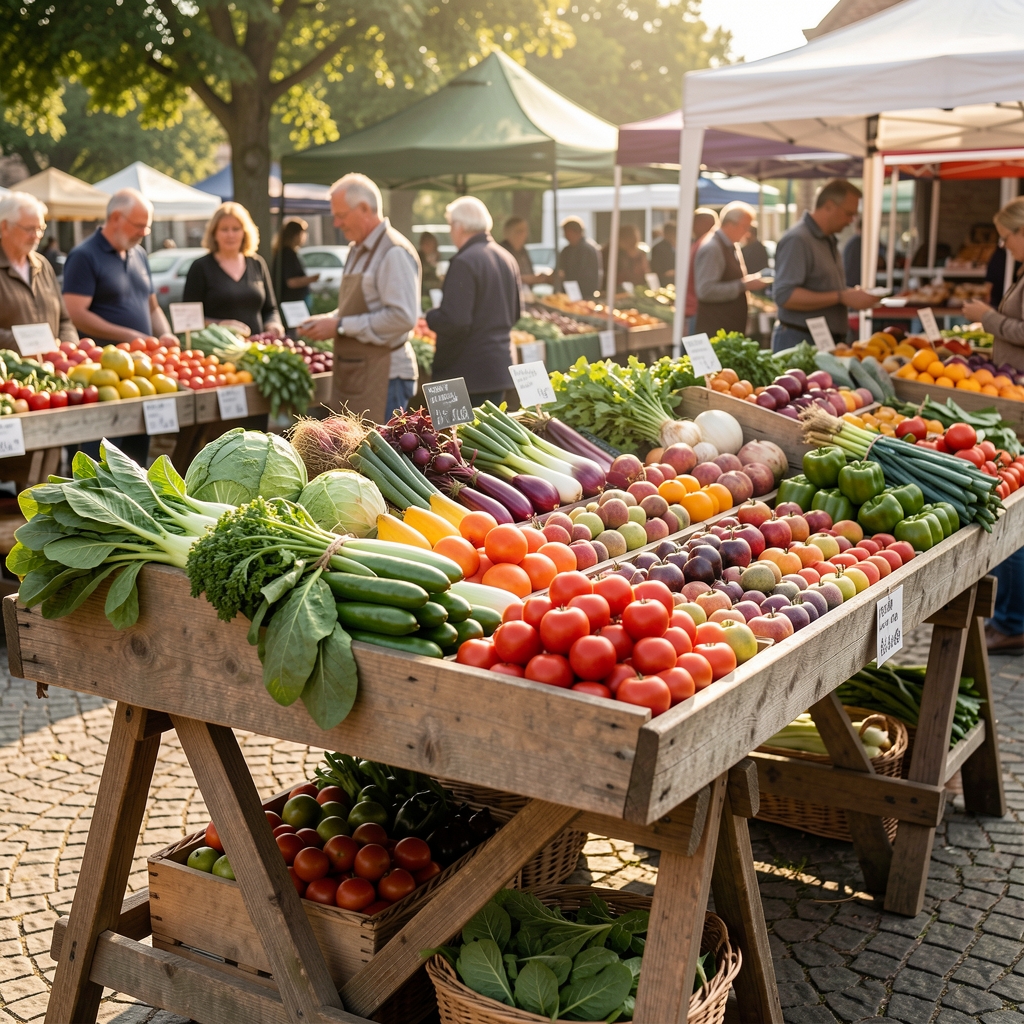
There is a practical consequence to eating with the season that goes beyond the frequently cited environmental arguments. When the weekly shop is anchored to what is currently in abundance — root vegetables in late autumn, green leaves and brassicas in winter, asparagus and broad beans in spring, tomatoes and courgettes in summer — the plate changes not by design but by availability. And when the plate changes in this way, the nutritional profile of the week's eating tends to change with it.
The Seasonal Shift in Dietary Variety
Dietary variety — the breadth of different plant foods eaten across a week — is one of the better-established markers of nutritional quality in the broader nutritional literature. It is not the only marker, and it is not an assurance of any particular health outcome, but it is a useful proxy for exposure to a wide range of micronutrients, phytochemicals, and fibre types that research associates with sustained nutritional adequacy.
What the seasonal approach provides is an external mechanism for achieving variety without deliberate planning. In January, the UK market is rich with celeriac, parsnip, leek, kale, and purple sprouting broccoli — foods that rarely appear in a summer basket. A summer shop dominated by courgettes, runner beans, cucumber, and fresh tomatoes will include entirely different phytochemicals and water contents. The shopper who follows the season does not need a diversity-maximising strategy. The season provides one automatically.
In the editorial journals examined over the past two years, participants who described shopping by what was most prominently available — at farmers' markets, in market halls, in the seasonal sections of larger supermarkets — reported higher week-to-week variety in their food records than those who maintained a fixed weekly list regardless of season. The fixed-list shoppers ate more reliably but more narrowly.

Fruit Intake and the Weekly Structure
Fruit intake presents an interesting pattern in the journals. It tends to be more consistent than vegetable intake — people who eat fruit at all tend to eat it regularly — but it is also more susceptible to seasonal collapse. When the core seasonal fruits (berries in summer, apples and pears in autumn, citrus in winter) are not prominently available or prominently displayed, fruit consumption tends to drop in favour of convenience snacks.
The practical implication is straightforward: fruit intake is partly a display and accessibility issue. Participants who kept a bowl of seasonal fruit visible on a kitchen surface ate more of it than those who stored fruit in a refrigerator drawer. This is a simple environmental nudge, not a nutritional intervention, but it surfaced consistently enough in the records to be worth noting.
The contribution of fruit to overall nutritional balance in these records was notable particularly in winter months. When fresh summer berries were unavailable, participants who substituted frozen berries, pomegranate seeds, or clementines maintained fruit intake in their records. Those who did not find a seasonal substitute showed a drop in fruit consumption that was not compensated for elsewhere in the weekly record.
Portion Awareness Through Seasonal Cooking
Cooking with seasonal produce tends to produce a more portion-aware engagement with food than cooking with processed or pre-portioned ingredients. A whole celeriac, a bunch of kale with thick stems, a bag of root vegetables — these require the cook to make decisions. How much of this? How will it fit alongside the protein? What will be left over and used tomorrow?
This decision-making process is a low-level form of portion awareness that is largely absent from convenience food preparation. It does not produce precise calorie counting, nor does it need to. What it produces is an active engagement with quantity, texture, and composition that leaves a trace in the food journal — and, over months, in the eater's intuitive sense of what a balanced plate looks like.
Several participants in the longer-term records described a shift in their relationship with plate composition over the course of a year of seasonal cooking. They did not describe following a dietary framework. They described a growing familiarity with volumes: how much of a vegetable cooked down to a satisfying portion, how a meal built around a large quantity of leafy greens felt different in the hours following it than a meal built around the same caloric volume of refined carbohydrates.

Weight Patterns Across Seasons
The relationship between seasonal eating and body weight is not straightforward. Seasonal produce tends to be lower in energy density than the processed alternatives it displaces — not because seasonal food is inherently sparse, but because whole vegetables and fruit contain high proportions of water and fibre, which contribute to volume and satiety without proportionally increasing energy intake.
In the records examined, weight was most stable in periods where seasonal produce formed the structural backbone of the week's eating. This stability was not dramatic — it was the absence of the small gains and recoveries that characterised the records of participants whose weekly food rhythm was less anchored to seasonal whole foods. Over a year, that absence of fluctuation is itself a meaningful pattern.
It is also worth noting that seasonal eating in the UK produces a natural variation in food temperature and preparation method. Winter months involve more cooked, warm dishes — soups, roasted vegetables, braised legumes. Summer months involve more raw preparations — salads, cold fruit, lightly dressed greens. These variations in preparation method correspond to shifts in satiety and in the time invested in meal preparation, both of which have indirect effects on eating rhythm and portion size.
The Practical Calendar of Seasonal Eating
For readers unfamiliar with the UK seasonal produce calendar, a brief orientation is useful. The following is not a comprehensive guide — it is a rough sketch based on what tends to dominate at well-stocked markets and greengrocers through the year.
Winter (December to February) offers the richest selection of root vegetables and brassicas: parsnip, celeriac, swede, winter cabbage, kale, Brussels sprouts, leek, purple sprouting broccoli. These are also the months for stored apples, pears, and forced rhubarb toward February's end, and for the peak of citrus availability from warmer climates.
Spring (March to May) brings asparagus — the most anticipated of British seasonal vegetables — alongside radishes, watercress, spring greens, spinach, and the first broad beans. Early strawberries begin to appear in May. The spring produce calendar is shorter than winter's but more varied in character, with a shift from dense root vegetables toward lighter, green-dominated plates.
Summer (June to August) is the most abundant period, with courgettes, runner beans, French beans, tomatoes, cucumbers, sweetcorn, and soft fruit — raspberries, gooseberries, blackcurrants, and the peak of the strawberry season — all available simultaneously. The summer diet naturally becomes lighter and higher in water content, which tends to correspond with lower energy density across the week's eating.
Autumn (September to November) bridges the abundance of summer and the rootedness of winter. Squash, pumpkin, late tomatoes, the first parsnips and leeks, wild mushrooms, and the full apple and pear season make this perhaps the most nutritionally diverse period of the year in terms of available whole foods.
A Note on Availability and Access
It would be incomplete to discuss seasonal eating without acknowledging that access to seasonal produce varies considerably by geography, income, and proximity to markets and greengrocers. The observations in this article are drawn from participants who had reasonable access to varied seasonal produce. The patterns described are illustrative of what the seasonal approach tends to produce when it is feasible, not a directive that assumes universal access.
Articles published on Tornela Press are editorial in nature and reflect the writers' observations on everyday nutrition practices and weight awareness. The content is not intended as professional advice, nor as guidance for the management of any specific condition. Readers with specific concerns about their daily routines are encouraged to speak with a qualified wellness professional.